
REVIEW · CITY TOURS
Durban City Sightseeing Tour
Durban tells its story in layers. I like the way this small-group tour connects Zulu traditions, colonial buildings, Indian influence, and beachfront life in one morning. I also like the personal touch from guides such as Leon, Paul, Togo, Wendy, and Thompson, who have been praised for making the city interesting and easy to understand. The main drawback is the tight three-hour schedule, especially since the museum, market, gardens, stadium, and beachfront all compete for your attention.
You pay $52.59 per person for hotel transport, a professional guide, the Botanic Gardens, and a visit to the African and Indian market at Warwick Triangle. Phansi Museum admission, food, and the Moses Mabhida Stadium cable car cost extra, and the museum is closed on weekends, so check the operating day before booking.
In This Review
- Key points to know before you book
- Why this short Durban tour works
- The Golden Mile: Durban beside the Indian Ocean
- Durban City Hall and the stories behind it
- Phansi Museum and Southern African traditions
- Botanic Gardens, founded in 1849
- Warwick Triangle and Durban’s Indian influence
- Moses Mabhida Stadium and the city from above
- What the $52.59 price really covers
- Timing, pickup, and the small details
- Who should choose this Durban introduction?
- Should you book this Durban city tour?
- FAQ
- How long does the Durban City Sightseeing Tour last?
- What time does the tour start?
- Where does the tour start?
- Does the tour include hotel pickup and drop-off?
- Is Phansi Museum admission included?
- Is Phansi Museum open on weekends?
- Is food included?
- Is the Moses Mabhida Stadium cable car included?
- How many people can join the tour?
Key points to know before you book
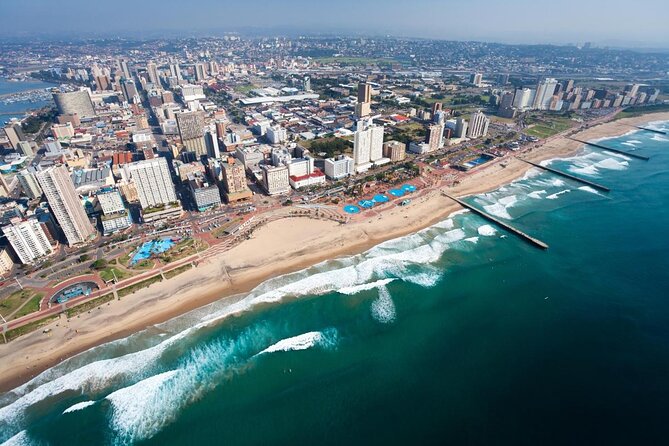
- Durban’s Golden Mile comes first: You begin with the city’s famous beachfront promenade, where hotels, restaurants, shops, and local seaside customs come together.
- The tour explains Durban through its people: Zulu traditions, colonial settlement, and Indian heritage all receive attention rather than being treated as separate footnotes.
- Phansi Museum is a strong cultural stop: Its collection includes Zulu jewelry, beadwork, clay pots, headrests, ceramics, and other Southern African objects.
- The Botanic Gardens date to 1849: You see large trees from Africa, Asia, and America, along with an orchid house, during a short included visit.
- Bunny chow adds a useful taste of Durban: Food is not included, but the tour explains the Indian influence on local cooking and may allow time to sample this well-known dish at your own cost.
- The group is capped at eight people: That is a useful size for questions and conversation, though the tour requires at least two people to operate.
Why this short Durban tour works
Durban can be hard to read at street level. Its broad beachfront, Indian markets, colonial public buildings, Zulu cultural traditions, and modern sports architecture do not automatically fit into one clear picture. This tour gives you a guide to connect those pieces.
I see the main value in the explanation. You are not simply driven past sights while someone recites names and dates. The route is designed to show how Durban grew through several communities and how those communities still shape daily life, food, religion, art, and public space.
The morning begins at 9:00 am and lasts about three hours. That makes it useful on a short stay, especially if you want a general introduction before spending later time at the places that interest you most. It also works well on a day when you have an afternoon activity planned.
The maximum group size is eight people, which should feel more personal than a large coach outing. A smaller vehicle can also make it easier to hear the guide and ask for clarification. The trade-off is that the route cannot give every attraction a long visit. Think of this as a guided orientation with several meaningful stops, not a series of leisurely museum visits.
More hop-on hop-off buses in Durban:
- Durban: City Sightseeing and Walking Tour
★ 4.6 · 98 reviews - Durban City Sightseeing and Walking Tour
★ 4.5 · 59 reviews - Cape Town: Hop-On Hop-Off Bus Tour with Optional Cruise
★ 4.8 · 3,929 reviews
The Golden Mile: Durban beside the Indian Ocean
The first major section takes you along Durban’s Golden Mile. This popular beachfront strip includes hotels, restaurants, shops, and a wide promenade. It gives you a quick sense of how strongly the city faces the sea.
The beachfront is also where the tour begins to show everyday Durban rather than only formal monuments. You might see traditional healers collecting seawater in bottles at the water’s edge for use as medicine. You may also notice Indian women in saris walking along the beach, enjoying the sunshine. These small details help you see the city as a lived-in place, not just a sightseeing route.
Your guide can provide context as you pass through the area, pointing out how the beachfront functions as both a leisure zone and a familiar part of local life. I like this early stop because it gives the rest of the tour a human setting. After the gardens and museum, you can return to the coast with a better idea of the communities that make Durban distinctive.
The limitation is time. The supplied schedule does not give a separate length for the promenade stop, so expect a drive and sightseeing pass rather than an extended beach visit. If you want to swim, sit by the water, or walk the full promenade, plan to return on your own.
Durban City Hall and the stories behind it
The route passes Durban City Hall, one of the city’s major civic landmarks. The guide adds amusing stories about its past, which can make the building more memorable than a simple photograph from a vehicle window.
This is a good example of why a local guide matters. A public building can look impressive but remain vague without context. Personal stories and unusual details help you understand how the city presents its past and how people remember it.
You should treat this part as a guided drive-by rather than a formal interior visit. The tour information does not include entry to City Hall, and the overall schedule leaves little room for a long stop. Still, it helps place the central city between the beach, cultural collections, and market area.
Phansi Museum and Southern African traditions
Phansi Museum is the most focused cultural stop on the route. The collection includes Southern African artifacts and traditions, with examples such as beadwork, headrests, Zulu clay pots, jewelry, ceramics, and other objects.
The museum matters because it gives you something concrete to look at while the guide discusses culture. You can see the skill and design in the objects rather than receiving only a broad explanation of Zulu life. The collection also creates a useful contrast with Durban’s colonial buildings and modern attractions.
You have about 30 minutes here, and the guide accompanies you through the museum. That should be enough to get a clear introduction, but not enough to study every display closely. If you already have a strong interest in Southern African art or material culture, you may want a separate visit with more time.
Admission is not included in the tour price. This is one of the costs to check before you decide if the package suits your budget. The museum is also closed to visitors on weekends, so a Saturday or Sunday booking will not provide the full advertised cultural experience. Confirm the available day before paying, especially because the cancellation policy is strict.
A few more in Durban
- Durban: 30-Minute Harbor Boat Cruise
★ 4.7 · 665 reviews - Durban: 1-Hour Boat Cruise from Wilson’s Wharf
★ 4.7 · 496 reviews - Durban Point Waterfront: Luxury Canal Boat Cruise
★ 4.4 · 298 reviews - Durban: Pontoon Boat Harbor Cruise
★ 4.4 · 182 reviews
Botanic Gardens, founded in 1849
Durban’s Botanic Gardens provide a quieter change of pace. Founded in 1849, the gardens contain large trees from Africa, Asia, and America, along with a notable orchid house.
The collection of plants reflects Durban’s links beyond South Africa. Instead of seeing a single regional garden, you get a mix of plant life from several parts of the world. The mature trees also give the stop a sense of age, which is useful in a city tour built around Durban’s long development.
The listed visit lasts about 20 minutes, and admission is included. That is convenient, but the short visit is the clearest sign that this is an introduction rather than a full garden tour. You can see the general character of the grounds and hear a little about the plants, but you should not expect a long walk through every section.
I would pay attention to the orchid house and the large trees first. With limited time, these are the features most likely to give you a memorable impression. If gardens are a major reason for visiting Durban, return later for a longer visit.
Warwick Triangle and Durban’s Indian influence
The tour includes a visit to the African and Indian market at Warwick Triangle. This is one of the most useful parts of the morning for understanding Durban’s Indian roots and the way food and commerce connect with the city’s past.
Durban’s Indian community grew from people who arrived during the 19th century as indentured servants. The tour explains how that history helped shape local culture, including cooking. This gives you more than a general statement about diversity. You see how migration became part of the city’s everyday identity.
The food reference here is bunny chow, a famous South African dish linked with Durban’s Indian influence. Food and drinks are not included, so any sample comes at your own expense. That is a reasonable arrangement because it lets you choose instead of adding a meal to the fixed price.
One practical point: the information does not give a specific amount of time for the market or promise a particular food stop. Ask your guide how much time is available before ordering anything. If the route is running late, you may need to choose between eating and spending more time at another stop.
Moses Mabhida Stadium and the city from above
The tour can finish with a cable car ride to the top of Moses Mabhida Stadium for views over Durban. The ride is optional and paid separately, so it is not part of the $52.59 base price.
This is a strong visual ending. After hearing about the city’s history and moving through cultural places, you get a chance to see Durban from above. The view can help you understand the relationship between the beachfront, central city, and wider urban area.
Because the cable car costs extra and the schedule is compact, confirm whether the ride is operating and how much time is available. The tour description presents it as an option, not a guaranteed included activity. If you want to take the ride, bring a payment method and keep the timing in mind.
What the $52.59 price really covers
At $52.59 per person, the tour is not simply a drive around town. The fee covers hotel pickup and drop-off, a professional guide, the Botanic Gardens visit, and the African and Indian market stop. It also gives you a small group capped at eight people, which adds value if you prefer direct conversation over a large bus commentary.
The price does not cover Phansi Museum admission, food or drinks, or the Moses Mabhida Stadium cable car. Those extras may be modest, but they matter when you are comparing this tour with a cheaper city drive.
I think the price is fair for a first visit if you value transport and historical explanation. You would have to arrange separate rides between several parts of Durban to recreate the route yourself, and you might miss the connections between the sights. The value is less convincing if you want long visits, extensive free time, or a full meal included.
The tour has a 4.4 rating from eight published ratings, with particularly strong praise for the guides. Specific names associated with positive experiences include Wendy, Thompson, Leon, Paul, and Togo. One account describes Togo as a Zulu guide who ended the tour with a bunny chow meal at the wharf, while other feedback praises the guides for being friendly, informed, neat, and helpful when a passenger became ill.
Those details suggest that the human side of the experience is a major reason to book. Guide quality can vary on any scheduled tour, but the repeated praise for clear explanations, kindness, and safe driving is encouraging.
Timing, pickup, and the small details
The official starting time is 9:00 am. Pickup is offered from selected central Durban hotels, while the stated meeting point is the Hilton Durban at 12-14 Walnut Road in Durban Central. Since the information gives both a hotel pickup service and a specific meeting point, confirm your exact pickup arrangement after booking.
The activity ends back at the meeting point. The advertised duration is approximately three hours, so allow for a compact morning rather than a full half-day away from your hotel.
Confirmation is sent within 48 hours of booking, subject to availability. At least two people are required for the tour to operate, and the maximum is eight. Most people can take part, but children up to age three must sit in a car seat. Seats depend on availability, so parents may bring their own.
The operator follows South African government approved TBCSA health and safety protocols. If you show COVID-19 symptoms, testing and quarantine are at your own cost, so suitable travel insurance is sensible.
The cancellation rule deserves careful attention. The experience is non-refundable and cannot be changed for any reason. Do not book until your date, pickup details, and museum availability are settled.
Who should choose this Durban introduction?
I would choose this tour if you have only a short time in Durban and want a guided first look at several parts of the city. It suits you if you care about local history, cultural objects, Indian influence, gardens, and practical transport more than extended time at one attraction.
It is also a good match for couples or small groups who want to ask questions. The maximum of eight people should make the morning more personal, and the guide names associated with positive feedback suggest that the company has produced some strong guide-led experiences.
Families can take part, but parents with very young children need to arrange a car seat. Anyone hoping for a relaxed beach day, a long museum visit, or a complete meal should adjust expectations.
I would avoid booking for a weekend unless the provider confirms an alternative to Phansi Museum. I would also avoid it if you need a flexible reservation, since changes and refunds are not allowed.
Should you book this Durban city tour?
Book it if you want a compact, guided introduction to Durban’s many communities and appreciate having transport between the main stops. The strongest reasons are the small group, the cultural explanation, the Botanic Gardens, the market visit, and the guides’ repeated praise for being friendly and informative.
Skip it if you want to set your own pace or spend hours at the gardens, museum, beach, or stadium. Before paying, confirm the weekday schedule, the exact pickup point, museum admission, cable car cost, and any food plans. For a first morning in Durban, this tour offers a useful framework for exploring more on your own afterward.
FAQ
How long does the Durban City Sightseeing Tour last?
The tour lasts approximately three hours.
What time does the tour start?
The stated start time is 9:00 am.
Where does the tour start?
The listed meeting point is Hilton Durban, 12-14 Walnut Road, Durban Central, Durban, 4001, South Africa.
Does the tour include hotel pickup and drop-off?
Yes. Hotel pickup and drop-off are included for selected Durban hotels. The activity ends back at the meeting point, so confirm your exact pickup arrangement after booking.
Is Phansi Museum admission included?
No. Admission to Phansi Museum is not included in the tour price.
Is Phansi Museum open on weekends?
No. Phansi Museum is closed to visitors on weekends.
Is food included?
No. Food and drinks are not included unless specifically stated. Bunny chow may be available to sample at your own expense.
Is the Moses Mabhida Stadium cable car included?
No. The cable car ride is optional and must be paid for separately.
How many people can join the tour?
The tour requires a minimum of two people and has a maximum group size of eight.
Just added in Durban
- Zulu Cultural Experience – Tour to the village of iSithumba and PheZulu★ 5.0 · 4 reviews
- Zululand 5 Day Private Safari from Durban★ 5.0 · 4 reviews
- Zulu Oracle & Herbalist Experience Day Tour★ 5.0 · 2 reviews
- Valley of a Thousand Hills – Durban★ 5.0 · 3 reviews
- Garden Route Durban to Cape Town via Addo National Park – 7 Days★ 5.0 · 15 reviews
- Durban: Go on Safari at 2 Game Reserves (Hluhluwe-Imfolozi) Pro Zeiss Binoculars★ 5.0 · 2 reviews
- Drakensberg, Nelson Mandela Capture S & Howick Falls – 2 Day Tour from Durban★ 5.0 · 3 reviews
- Hluhluwe Imfolozi Game Reserve & Phezulu Safari Park from Durban★ 5.0 · 4 reviews
City Tours, compared.
Cape Town Hop-On Hop-Off City Tour with Optional Cruise
Read our review →
Jo’berg in 1 Day: Soweto, Apartheid Museum & City Tour
Read our review →
Cape Town City Pass: Save Over 50% on 80+ Top Attractions
Read our review →
Hop-On Hop-Off Bus, City Tour and Apartheid Museum
Read our review →

From Sun City: Pilanesberg National Park 3-Hour Game Drive
Read our review →
Browse the lists this tour appears in