
REVIEW · CITY TOURS
Johannesburg City Centre Walking Tour
Johannesburg makes more sense on foot. This three-hour tour gives you a guided look at the city centre, moving from Gandhi Square and Main Street to places tied to working life, politics, and South Africa’s long road toward democracy. I like the mix of serious history and ordinary city life, and I especially like that the tour finishes with a South African braai in the arts-focused Maboneng Precinct. The small group limit of 10 also makes it easier to ask questions and keep close to your guide.
The biggest consideration is that Johannesburg’s centre can feel confronting. You will see lively streets, striking old buildings, public art, and local daily life, but you may also notice decay and areas where you should not wander alone. The guide’s safety judgment is a major part of the value here, and the walking can be tiring in the city’s heat.
In This Review
- What makes this Johannesburg walk worthwhile
- Starting at Gandhi Square and Main Street
- The Workers Museum and Johannesburg’s working story
- Chancellor House and the legal fight against apartheid
- Mary Fitzgerald Square and the city’s public voice
- The Top of Africa and a change of scale
- Moving toward Maboneng for lunch
- A South African braai to finish
- The guides and the safety question
- How the timing and group size affect the experience
- Who should book this walk?
- My verdict on the $45.19 price
- Should you book the Johannesburg City Centre Walking Tour?
- FAQ
- How long is the Johannesburg City Centre Walking Tour?
- Where does the tour begin?
- Where does the tour end?
- What places are included in the walking route?
- Is lunch included?
- How many people can join the tour?
- Is the tour suitable for most people?
- Can I cancel for a full refund?
What makes this Johannesburg walk worthwhile

- Chancellor House connects you to Mandela and Tambo: Visit the former office where Nelson Mandela and Oliver Tambo established South Africa’s first Black-owned law firm.
- The Workers Museum adds human scale: This former compound helps explain the working lives behind Johannesburg’s growth.
- Main Street delivers old-city character: Look for heritage buildings and the marks left by the gold economy.
- The Top of Africa changes your view: The skyscraper viewpoint offers broad city views after your street-level walk.
- Maboneng supplies the social finish: Art, music, crafts, and a braai give the tour a relaxed ending.
- Local guides make the difference: Guides including Tebogo, Mathapelo, Mulalo, Kutlwano, Clement, and Sibongile have been praised for clear explanations, local insight, and careful attention to safety.
Starting at Gandhi Square and Main Street
The meeting point is outside Nando’s at Gandhi Square, at Shop 180 in the Metropolitan Building on Rissik Street, Marshalltown. This is a practical starting place because the square is central and near public transportation. The group is limited to 10 people, so you are not likely to be lost in a large crowd.
Gandhi Square gives the tour an immediate sense of Johannesburg’s layered past. The area is tied to Mahatma Gandhi’s time in South Africa, while the surrounding streets show how the modern city has changed. Your guide can help you read the area as more than a transport hub or photo stop.
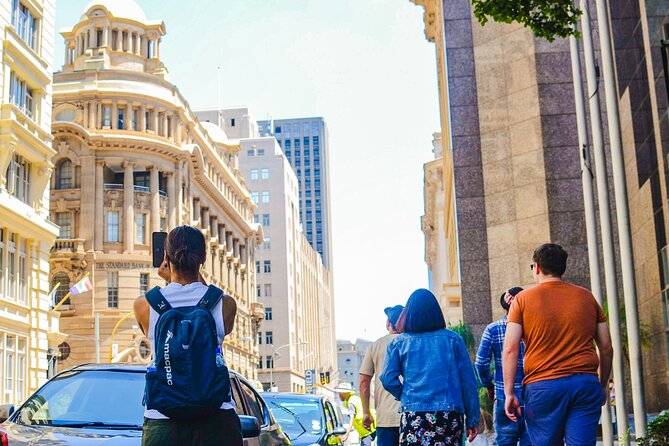
From there, the walk reaches Main Street, where old commercial buildings recall Johannesburg’s early growth. You get about 30 minutes here. That is enough time to hear the basic story, look up at the architecture, and take photographs without turning the stop into a long lecture.
I like this opening because it starts with the city itself rather than a polished attraction. You hear traffic, see people going about their business, and begin to understand Johannesburg as a working centre. The trade-off is that this is not a tidy open-air museum. Pavements, noise, and changing conditions are part of the experience.
Keep your belongings close and stay with the group. The point is not to act frightened, but to let your guide choose the sensible route and pace.
More Walking Tours in Johannesburg
- Soweto: Walking Tour with a Local Guide and Lunch
★ 4.9 · 648 reviews - Soweto Walking Tour with Lunch
★ 5.0 · 288 reviews - Johannesburg: Local Food Tasting Guided Walking Tour
★ 4.7 · 192 reviews
The Workers Museum and Johannesburg’s working story
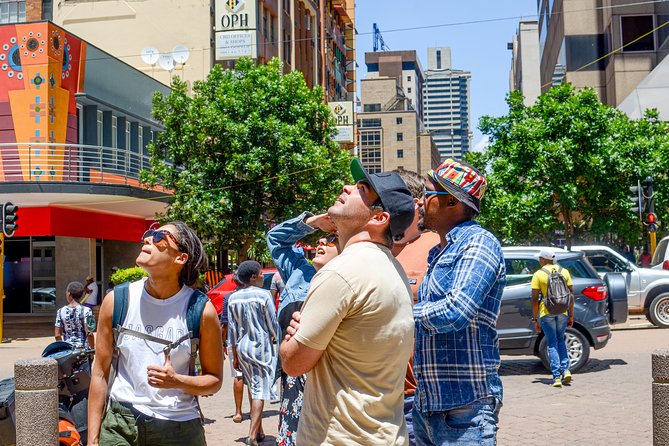
The Workers Museum is scheduled for about 20 minutes. It occupies a former compound, a type of accommodation connected to the migrant labour system that shaped Johannesburg and South Africa’s mining economy.
This stop matters because the city’s story is often told through mines, money, famous politicians, and grand buildings. The Workers Museum shifts attention to the people whose labour made that economy possible. You get a more grounded picture of how workers lived and how movement for employment affected families and communities.
Allow yourself time to look closely rather than rushing for photographs. The museum is one of the most useful stops for visitors who want social context, not just dates and landmark names. A guide can connect what you see indoors with the streets outside.
The scheduled visit is short, so do not expect a full museum afternoon. If this is the part of Johannesburg’s story that interests you most, you may want to return independently if time allows. The tour gives you an introduction and, more importantly, shows you why the site matters.
Chancellor House and the legal fight against apartheid
Chancellor House receives about 15 minutes. This was the office associated with Nelson Mandela and Oliver Tambo, who founded South Africa’s first Black-owned law firm. The building links Johannesburg’s urban centre with the legal and political work that challenged apartheid.
The value of this stop lies in its setting. You are not only hearing about Mandela as a national figure. You are standing at a place connected to his working life, when he and Tambo represented clients facing a deeply unequal legal system.
I would pay close attention to the guide here. Fifteen minutes passes quickly, and the meaning of Chancellor House comes through best in the explanation around the building. The stop is modest in length, but its historical weight is considerable.
It also helps balance the Workers Museum. One site focuses on working people and the economic system around them. The other shows how law, political pressure, and personal courage began to challenge that system. Together, they make the city centre feel connected rather than a string of unrelated buildings.
Mary Fitzgerald Square and the city’s public voice
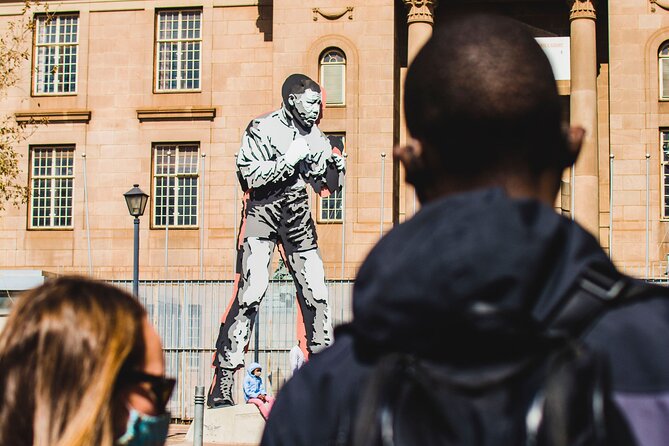
The walk continues to Mary Fitzgerald Square, with roughly 10 minutes set aside. The square is often used for meetings and public gatherings, so it offers a useful way to think about Johannesburg as a place where civic life happens in public.
This is a shorter stop, but it breaks up the indoor and architectural visits. You can pause, take in the square, and hear how public spaces have been used for organised action and community life.
The tour also gives you a brief look at Johannesburg as a living city, not only as a historical subject. Guides have been praised for talking about music, local culture, and everyday life alongside political history. That wider conversation is one reason this walk feels more personal than a standard landmark circuit.
Do not expect every stop to have a polished presentation or a long visit. The appeal is the connection between places, and your guide’s ability to explain what you are seeing.
Something quite different:
- From Johannesburg: Pilanesberg Nature Reserve Game Safari
★ 4.8 · 1,327 reviews - Johannesburg: Hop-On Hop-Off Bus with Optional Soweto Tour
★ 4.6 · 985 reviews - Soweto /Johannesburg and Apartheid Museum Guided Full Day Tour
★ 5.0 · 932 reviews - Johannesburg Hop-On Hop-Off City Tour with Soweto Option
★ 4.5 · 768 reviews
The Top of Africa and a change of scale
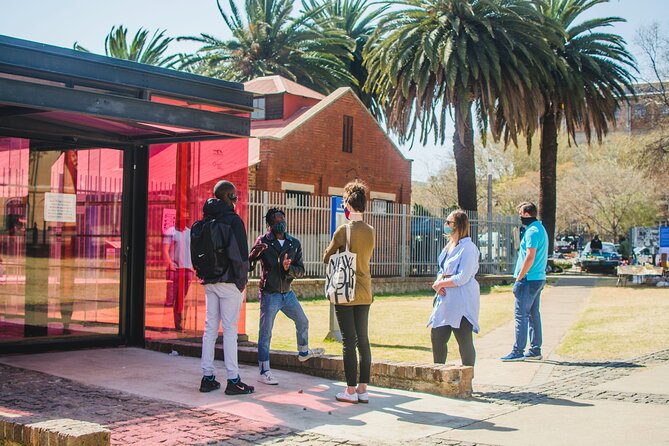
The experience includes city views from the Top of Africa skyscraper. After walking through streets and squares, this higher viewpoint gives you a different sense of Johannesburg’s size and shape.
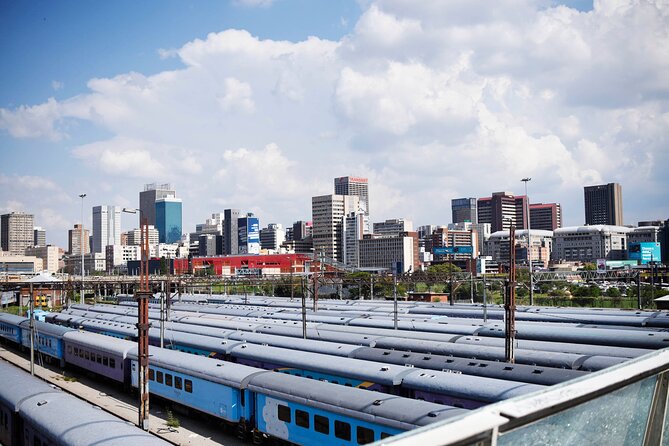
From ground level, the city can feel like a series of busy blocks. From above, you can place those streets within the larger urban area and better understand the scale of South Africa’s biggest and richest city. It is also a natural spot for photographs.
The supplied schedule does not give a separate time allocation for the Top of Africa, so the exact timing may depend on the day’s route and access. If the viewpoint is a priority for you, confirm how it fits into the schedule before booking.
This is a good example of why a guided walk works well here. Street-level detail gives you atmosphere, while the high viewpoint gives you orientation. You get both the close-up and the broad view in one short outing.
Moving toward Maboneng for lunch
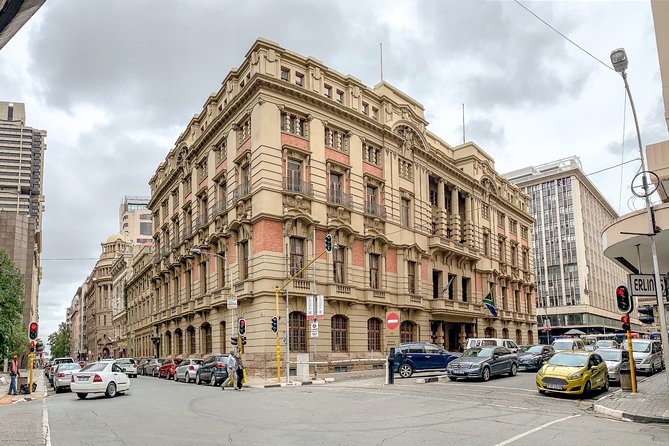
The walking portion finishes by heading toward the Maboneng Precinct, with transport possibly used for part of the connection. One account describes the guide arranging an Uber from Gandhi Square to Jewel City and Maboneng, while another mentions a taxi ride as a memorable part of the day.
That detail matters. This is not necessarily three uninterrupted hours of walking from one attraction to the next. The route can include a short vehicle transfer when it makes sense for safety or distance. Your guide may help arrange the ride, but additional transport costs are not clearly included in the stated price, so clarify this before you set out.
Maboneng changes the mood. The precinct is associated with art, music, crafts, and restaurants, and it provides a more relaxed setting after the denser historical portion of the walk. You get a chance to see a different side of Johannesburg, one shaped by creative projects and social activity.
The area is also a reminder that city districts can change quickly. The tour does not present Johannesburg as one simple story of decline or renewal. You see attractive public spaces and creative energy alongside more difficult urban realities.
A South African braai to finish
The final meal is a South African braai, or barbecue, in Maboneng. This is more than a convenient lunch break. Food gives you a direct way to experience local culture, and a braai is a fitting end to a walk that has focused on ordinary city life as much as famous names.
Plant-based options are available, which makes the meal more useful for mixed groups. Specific dishes are not guaranteed, but one meal account praised the chakalaka, a spicy vegetable relish often served with South African food. You should tell the operator about dietary needs when booking rather than wait until lunch.
There is one point to check carefully. Water is explicitly included, while the general terms also say additional items and costs are not included. The experience description presents the braai lunch as part of the day, but the exact inclusion details are not perfectly clear. Confirm what the $45.19 price covers, including lunch and any vehicle transfer.
That small bit of homework protects the tour’s value. At $45.19 per person, the price is reasonable if it covers the guide, water, main visits, transport connection, and braai. It is less attractive if you must add substantial costs for food and taxis.
The guides and the safety question
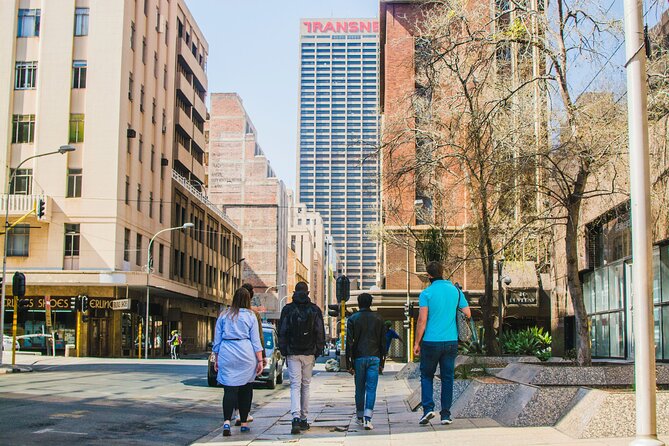
The guide is the key reason to book this experience. Tebogo Siwela has been praised for mixing history, music, and practical city knowledge. Mathapelo has been singled out for honest explanations, careful hosting, and answers to detailed questions. Mulalo, Kutlwano, Clement, and Sibongile have also been praised for warmth, local insight, and personal attention.
Those comments point to a consistent strength: the guides do not simply recite facts. They help you understand when to pause, where to walk, and when it is wiser to use a car. Sibongile even helped arrange an Uber and checked that a participant reached the hotel safely.
That does not mean the centre is risk-free. A guided group reduces uncertainty, but you still need normal city awareness. Keep valuables discreet, follow the guide’s instructions, and do not split off without asking. One guide arranged a taxi through an area considered less safe, which is exactly the kind of practical decision that adds value.
The tour is described as suitable for most people and near public transportation. Still, it is a three-hour city walk. Wear comfortable shoes, bring sun protection, and carry only what you need.
How the timing and group size affect the experience
At approximately three hours, the tour is long enough to introduce several parts of Johannesburg without consuming your whole day. It works well on a first morning in the city, when you want orientation before choosing what to explore next.
The 10-person maximum is a real advantage. Small groups make it easier to hear the guide near traffic and easier to ask about sensitive or complicated subjects. They also make street crossings and group movement less awkward.
The schedule is fairly active. Main Street receives the longest stated stop, while Chancellor House and Mary Fitzgerald Square are shorter. The day is best for people who prefer a broad introduction with several connected sites, not for anyone who wants an hour at each museum.
The average booking lead time is 21 days, so reserving ahead is sensible if your dates are fixed. Free cancellation is available up to 24 hours before the start time for a full refund. Changes or cancellations inside that window are not accepted for a refund.
Who should book this walk?
I would recommend it most strongly to first-time visitors who are curious about Johannesburg but uneasy about navigating the centre alone. It is also a good match for anyone interested in apartheid-era history, working-class life, architecture, public art, and local food in one outing.
It suits independent-minded people who still want a local safety net. You are not sealed inside a tour bus, yet you are not expected to work out every route and transfer yourself.
Families and older participants should consider the walking pace and city conditions. The activity is described as suitable for most people, but individual comfort with heat, pavement, traffic, and a three-hour outing matters.
This is less ideal if you want a formal museum tour, a luxury meal, or a tightly timed itinerary with every entrance and transfer clearly itemised. It is also not the right choice if you prefer to see only polished tourist districts. Johannesburg’s rough edges are part of what you will encounter.
My verdict on the $45.19 price
The price buys more than a walk between landmarks. You are paying for local judgment in a city that can be difficult to read, plus historical explanation, a small group, city views, and a meal experience that helps connect the past with present-day life.
The value depends on what is included on your date. Water is included, but additional costs are not. Because the braai and transport details are not fully spelled out, ask for a clear breakdown before paying.
With that confirmed, I think the tour offers good value for a first look at central Johannesburg. The strongest part is not any single building. It is the way the guide links Gandhi Square, Main Street, the Workers Museum, Chancellor House, Mary Fitzgerald Square, the Top of Africa, and Maboneng into one readable story.
Should you book the Johannesburg City Centre Walking Tour?
Book it if you want to meet Johannesburg on its own terms: historical, busy, creative, uneven, and full of daily life. The standout strengths are the guides, the careful approach to safety, the small group, and the braai lunch with plant-based choices.
Before booking, confirm whether lunch and any taxi or Uber transfer are included in the $45.19 price. If the answer is clear and you are comfortable walking for three hours, this is a strong introduction to the city centre. If you want a quiet, polished sightseeing experience, choose another outing.
FAQ
How long is the Johannesburg City Centre Walking Tour?
The tour lasts approximately three hours.
Where does the tour begin?
It begins outside Nando’s at Gandhi Square, Shop 180, Metropolitan Building, Rissik Street, Marshalltown, Johannesburg.
Where does the tour end?
The stated end point is Constitution Hill Human Rights Precinct, 11 Kotze Street, Braamfontein, Johannesburg. The experience also ends with lunch in the Maboneng Precinct, so confirm the final drop-off details when booking.
What places are included in the walking route?
The route includes Main Street, the Workers Museum, Chancellor House, Mary Fitzgerald Square, and other parts of Johannesburg’s city centre. It also includes city views from the Top of Africa and a visit to the Maboneng Precinct.
Is lunch included?
A South African braai lunch is presented as part of the experience, with plant-based options available. Water is included, but additional items and costs are not. Confirm the exact lunch inclusion before booking.
How many people can join the tour?
The tour has a maximum of 10 participants.
Is the tour suitable for most people?
Yes. The activity information says most people can participate, and the tour is near public transportation. You should still be comfortable with approximately three hours of city walking.
Can I cancel for a full refund?
Yes. You can cancel at least 24 hours before the start time for a full refund. Cancellations or changes made less than 24 hours before the start time are not accepted for a refund.
Just added in Johannesburg
- Pretoria Capital City Tour Experience★ 5.0 · 24 reviews
- 4 Day Kruger National Park Tour★ 5.0 · 30 reviews
- Johannesburg e-scooter experience★ 5.0 · 38 reviews
- Johannesburg Street Art & Museum Walking or E-scooter Tour★ 4.5 · 10 reviews
- Big 5 Safari Experience at Pilanesberg National Park★ 5.0 · 16 reviews
- Arrival Private Transfer: Tambo Airport JNB to Johannesburg in Business Car★ 4.0 · 5 reviews
- Drakensberg Mountains. Tugela Gorge and Amphitheater Hike★ 5.0 · 7 reviews
- Apartheid Museum Tour from Johannesburg★ 4.5 · 14 reviews
City Tours, compared.
Cape Town Hop-On Hop-Off City Tour with Optional Cruise
Read our review →
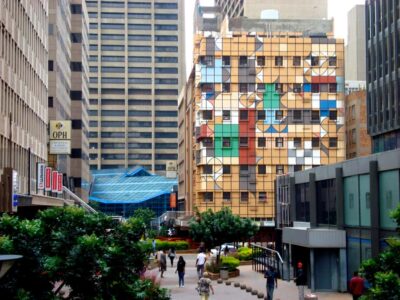
Jo’berg in 1 Day: Soweto, Apartheid Museum & City Tour
Read our review →
Cape Town City Pass: Save Over 50% on 80+ Top Attractions
Read our review →
Hop-On Hop-Off Bus, City Tour and Apartheid Museum
Read our review →

From Sun City: Pilanesberg National Park 3-Hour Game Drive
Read our review →
Browse the lists this tour appears in