
REVIEW · CITY TOURS
Johannesburg: City Centre Walking Tour
Johannesburg makes more sense on foot. This three-hour walk links Gandhi Square, the old gold-mining core, Chancellor House, Newtown, and Mandela Bridge, giving you history alongside a clear look at present-day Johannesburg. I especially like the honest attention to current city life and the chance to see places such as Nelson Mandela and Oliver Tambo’s former law office, not just polished tourist sights. I also like that the tour ends in Braamfontein, where the city’s youthful arts scene feels far removed from the office towers of Sandton.
The main thing to consider is that this is a serious urban walk, not a gentle sightseeing stroll. Pavements, city conditions, weather, and museum opening hours can affect the experience. The Workers Museum has sometimes been closed, and access to the Carlton Centre’s famous upper-level view has also changed, so you should confirm what is open on your date.
In This Review
- Key points at a glance
- Why this is a useful first look at Johannesburg
- Gandhi Square and the first gold stories
- Courts, public buildings, and the city’s political story
- Chancellor House and Mandela’s Johannesburg
- The Workers Museum and migrant labour
- Mary Fitzgerald Square and the Market Theatre
- Mandela Bridge and the walk toward Braamfontein
- Safety, comfort, and the practical side of walking
- Is $40 a fair price?
- Who should book this Johannesburg walk?
- Final verdict: book it for context, not polish
- FAQ
- Where does the Johannesburg City Centre Walking Tour begin?
- How long does the tour last?
- What language is the tour conducted in?
- Is lunch included?
- Are entrance fees and water included?
- Is the tour wheelchair accessible?
Key points at a glance

- Gold began the story at Ferreirasdorp: See where Johannesburg’s first diggers settled and where the early gold workings began.
- Mandela’s working life gets its own stop: Chancellor House recalls the law firm Nelson Mandela and Oliver Tambo founded together.
- Newtown adds social history: The Workers Museum explains migrant labour and the conditions that shaped Johannesburg.
- The guide makes the difference: Refiloe receives especially strong praise for his warmth, humor, local knowledge, and care with route planning. Mulalo, Mathapelo, Thabo, and other guides have also led highly regarded tours.
- The route crosses several sides of Johannesburg: You move from financial streets to courts, cultural spaces, public squares, and the creative districts of Newtown and Braamfontein.
- Plan for a flexible three hours: Some private groups have continued for four hours, but the advertised walk lasts three hours and includes plenty of time on foot.
Why this is a useful first look at Johannesburg
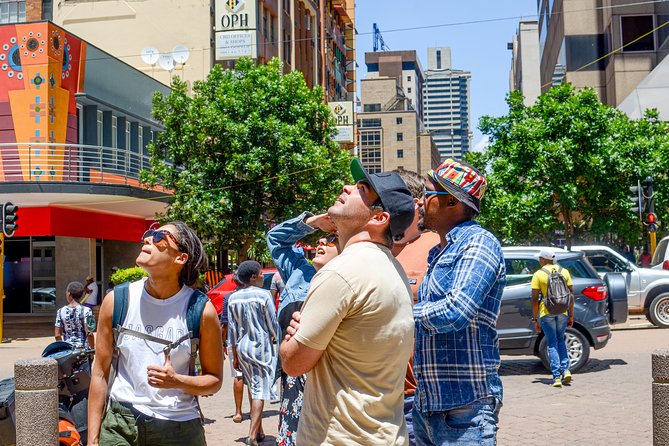
Johannesburg can be hard to read from a car window. You pass tall buildings, busy streets, boarded storefronts, public art, and grand old facades, but the connections between them are not always obvious. This tour gives you those connections one step at a time.
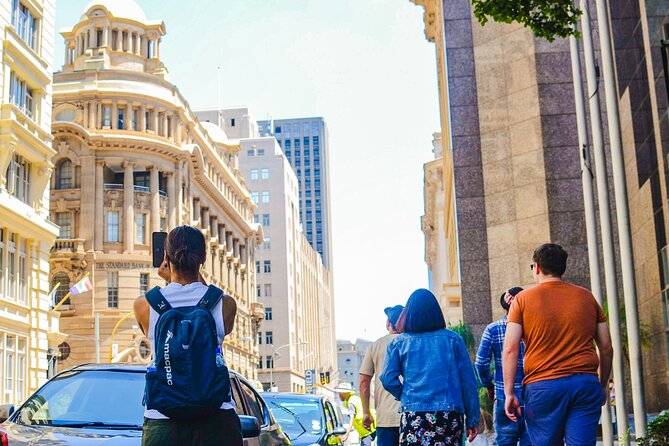
You begin at Nando’s outside the Metropolitan Building area on Gandhi Square. That location matters because the walk starts in the central business district, close to the city’s early commercial core rather than in the more polished northern suburbs. From the outset, your guide can explain how gold drew people here and how the city grew around mining, finance, courts, transport, and migrant labour.
I like the way the tour deals with both pride and difficulty. You hear about Johannesburg’s architecture, political importance, and cultural energy, but also about the condition of the CBD and the challenges affecting it today. Several guides are praised for making visitors feel safe while still presenting the city as it is, not as a sanitized attraction.
That balance is the chief reason to choose this walk instead of a sightseeing bus. A bus can cover more ground, but walking lets you notice how districts change from one block to the next. You are close enough to look at building details, public squares, street art, and the everyday movement of the city.
More Walking Tours in Johannesburg
- Soweto: Walking Tour with a Local Guide and Lunch
★ 4.9 · 648 reviews - Soweto Walking Tour with Lunch
★ 5.0 · 288 reviews - Johannesburg: Local Food Tasting Guided Walking Tour
★ 4.7 · 192 reviews
Gandhi Square and the first gold stories
Gandhi Square is the practical starting point. Look for your guide outside Nando’s, near the Metropolitan Building. The meeting point is central, but allow a little time to find the exact spot, since the square and nearby buildings can feel confusing if this is your first visit.
The early part of the walk introduces Johannesburg’s gold-mining origins. Main Street is important here because its buildings and street plan reflect the city’s connection to mining wealth. Your guide uses the architecture to explain how a mining settlement grew into South Africa’s economic center.
Ferreirasdorp is one of the most meaningful early stops. It is often called the cradle of Johannesburg because the first gold diggings began here and the first diggers settled nearby. This is not just an old name on a map. It gives you a physical point from which to understand why Johannesburg exists where it does.
The tour also passes through Marshalltown and pauses at the Marshalltown Post Office. These stops help broaden the picture beyond one famous landmark. You see how government services, commercial activity, and public buildings formed part of the city’s early structure.
At the Carlton Centre, the guide sets aside about 20 minutes. The building is one of Johannesburg’s best-known high-rise landmarks, and its position makes it a natural place to discuss the city skyline and changing fortunes. You should check ahead about access to the upper viewing area, however. A past tour encountered a closed viewing facility, and the guides offered another way to see the skyline instead.
Courts, public buildings, and the city’s political story
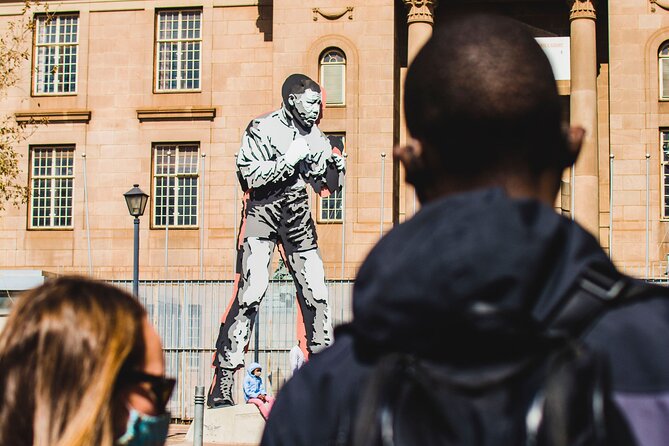
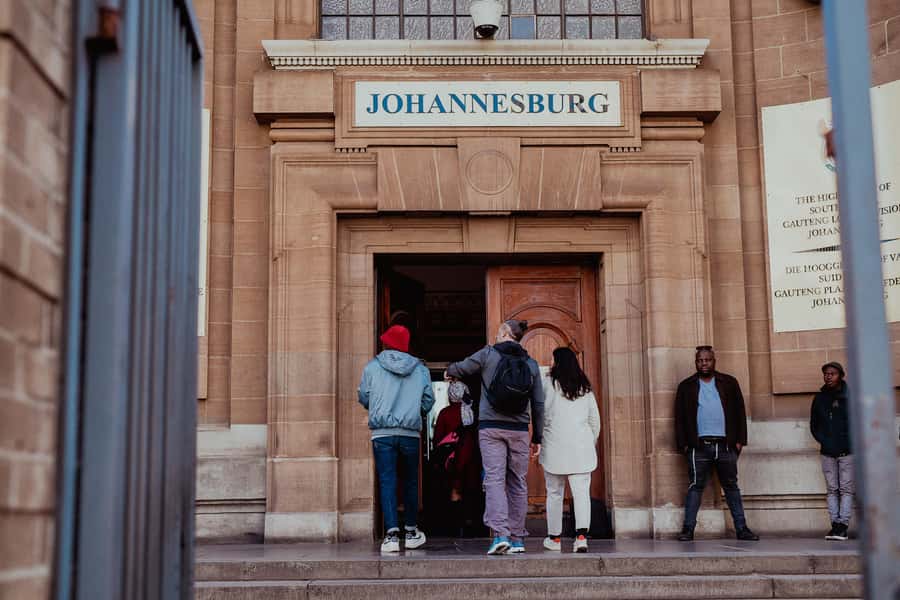
The route then moves through a group of civic and legal buildings, including the High Court of South Africa, Gauteng Local Division, and the Johannesburg Central Magistrate’s Court. These are not quick photo stops with no explanation. Your guide uses them to discuss the law, public authority, and the political forces that shaped South Africa.
The High Court visit lasts about 20 minutes, while the magistrate’s court receives roughly the same amount of time. You can expect exterior sightseeing, photographs, and commentary rather than a courtroom tour. The buildings are valuable because they place national political history in ordinary city streets.
The Marshalltown Post Office stop takes about 10 minutes. It is shorter, but it adds another layer to the route by showing how civic infrastructure supported the growing city. As you walk, your guide may also point out how older structures sit beside newer businesses and buildings in very different condition.
Beyers Naude Square receives around 20 minutes and offers another pause for photographs and discussion. The square helps break up the walking and gives you space to take in the surrounding streets. I would use these pauses to ask questions, especially if you want more detail about apartheid, Gandhi, Mandela, or the current politics of the CBD.
The Anglo American corporate office is a shorter stop of about 10 minutes. Its presence brings the story back to the companies and mining wealth that helped shape Johannesburg. The contrast between corporate power and the social history of migrant workers becomes clearer as the tour continues.
Chancellor House and Mandela’s Johannesburg
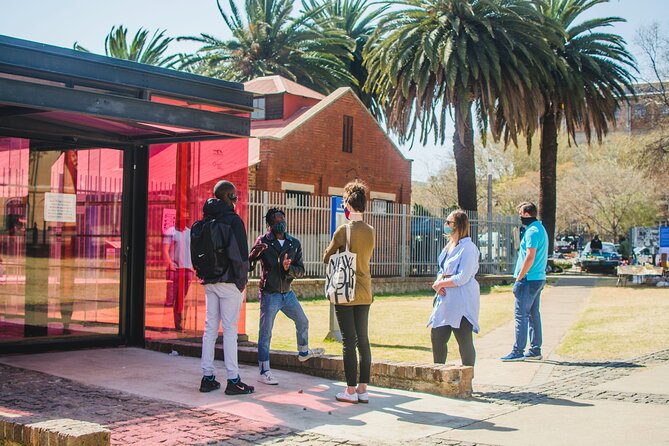
Chancellor House is one of the most personal historical stops. Nelson Mandela and Oliver Tambo established their first black-owned law firm here, making the building a direct link to their professional lives and to the struggle against apartheid.
This stop works well because it shows Mandela as a working lawyer, not only as a global political symbol. You get a sense of the practical setting in which he and Tambo dealt with the legal system and the pressures faced by black South Africans.
The tour description places Chancellor House between Ferreirasdorp and Newtown. The timing may vary depending on the walking pace and group size, but it is an important part of the historical thread. If you have already visited major Mandela sites elsewhere in South Africa, this stop still adds something different by focusing on his legal career.
The guides are a major strength here. Refiloe is repeatedly praised for explaining complicated South African history in a clear, lively way. Mathapelo has also been described as warm and passionate, while Thabo and Mulalo have been singled out for making the walk both informative and comfortable.
Some bookings become private tours when no other participants join. That can be a real advantage if you want to ask detailed questions, though you should not assume you will receive a private guide. Group size is not specified, and the experience may vary with the number of people booked.
Something quite different:
- From Johannesburg: Pilanesberg Nature Reserve Game Safari
★ 4.8 · 1,327 reviews - Johannesburg: Hop-On Hop-Off Bus with Optional Soweto Tour
★ 4.6 · 985 reviews - Soweto /Johannesburg and Apartheid Museum Guided Full Day Tour
★ 5.0 · 932 reviews - Johannesburg Hop-On Hop-Off City Tour with Soweto Option
★ 4.5 · 768 reviews
The Workers Museum and migrant labour
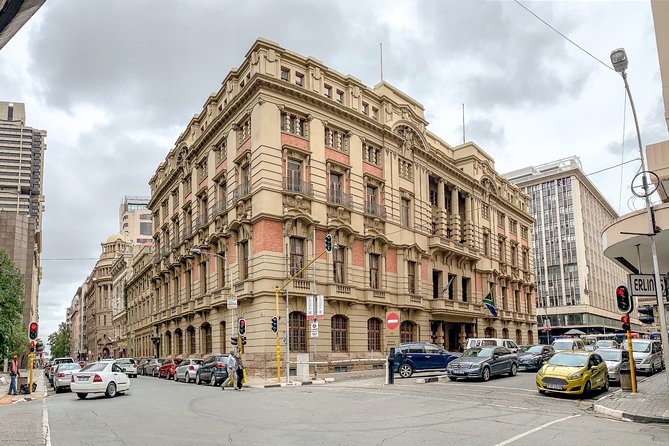
Newtown changes the mood of the walk. This part of Johannesburg is associated with creative spaces, public art, galleries, music, and theatre, but it also carries the memory of workers whose labour helped build the city.
The Workers Museum is the key stop. It focuses on migrant labour and the living conditions imposed on workers, giving you a social history that can be missed if you only visit financial districts and political landmarks. The museum helps explain how Johannesburg depended on workers who were separated from their families and controlled by a harsh labour system.
The planned stop is about 15 minutes, with time for a visit, photographs, and explanation. The museum’s opening schedule matters. It has been closed on some Mondays, and when that happens the guide can still explain the workers’ living conditions, but you will not see the interior displays.
That possibility is worth checking before you book for a Monday. It does not make the whole tour poor, since the guide can provide context, but the museum is one of the places where the route’s social history becomes especially concrete.
Mary Fitzgerald Square and the Market Theatre
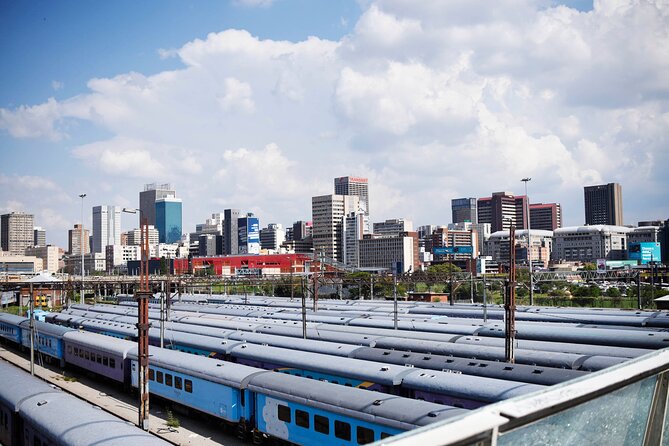
Mary Fitzgerald Square gives you another open public space in Newtown. The stop lasts about 15 minutes and is useful for understanding how the neighborhood has been used for public gatherings, cultural activity, and urban renewal.
The Market Theatre follows, with about five minutes listed for the visit and a walk past. It has an important place in South African cultural life and is tied to theatre, political expression, and the creative identity of Newtown. Since the stop is brief, do not expect a full performance or long interior visit.
The route may also include street art, galleries, and other cultural spaces along the way. The exact amount you see can depend on the guide, the day, and the pace of the group. If art is your main interest, One Day Africa also offers a separate street art tour, which could be a better choice for a fuller look at Johannesburg’s murals and creative work.
I like this part of the route because it prevents the tour from becoming a parade of old buildings. You see how Johannesburg’s past continues to shape its arts scene, and how Newtown offers a different kind of public life from the commercial center.
Mandela Bridge and the walk toward Braamfontein
Nelson Mandela Bridge is one of the clearest photo moments on the route. The bridge connects neighborhoods and gives you a changing view of the city as you walk across or near it. The listed stop is about 10 minutes, including photographs, sightseeing, and scenic views along the way.
The bridge also works as a symbol without needing much explanation. It links parts of Johannesburg that can feel separate, and it provides a memorable final landmark before the tour moves toward Braamfontein.
Braamfontein is the finishing area, with the tour ending at Sha’p Braai, a shisanyama restaurant. Lunch is not included, but finishing at a place associated with South African grilled meat gives you a convenient chance to continue the experience on your own. The food itself is not part of the included package, so budget separately if you plan to eat there.
The final district has a youthful, creative feel and is known for its effect on Johannesburg’s culture. Ending here gives the walk forward momentum. You finish not only with the story of how the city began, but also with a sense of where parts of Johannesburg are heading.
Safety, comfort, and the practical side of walking
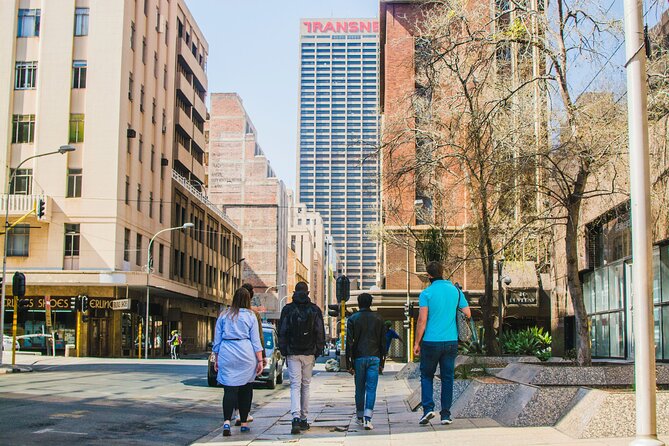
Safety is a central concern for many people considering a Johannesburg CBD walk. The strongest recurring praise for this experience concerns guides who know which streets are suitable and help visitors feel looked after. Refiloe, Clement, Mathapelo, Tebogo, Thabo, and Mulalo have all been praised for their care or local insight.
That said, a guide cannot remove every feature of a large city center. Stay with the group, follow the guide’s directions, and keep valuables discreet. This is a walking tour through an active urban area, not a controlled attraction.
Wear comfortable shoes. The route lasts three hours and includes repeated walking between stops, with pauses for photos and explanations. Bring water, although a bottled water supply is included, and dress for the weather.
The tour is described as suitable for all ages, but the practical notes also say it is not suitable for pregnant women. The information about wheelchairs is inconsistent: one section describes the activity as wheelchair accessible, while another says it is not suitable for wheelchair users. If access is important to you, contact One Day Africa before booking and ask about the exact route and current conditions.
English is the stated tour language. Entrance fees and the guide are included, but hotel pickup, drop-off, and lunch are not. You need to reach Gandhi Square yourself and arrange your own way back after the meal stop or the end of the walk.
Is $40 a fair price?
At $40 per person, this is not the cheapest way to look at Johannesburg, but the price is reasonable if you want a guided introduction to the CBD rather than a quick ride past it.
You are paying for three hours of guiding, entrance fees, bottled water, and a route that joins mining history, apartheid-era politics, architecture, migrant labour, theatre, street culture, and present-day urban issues. The value is strongest when your guide adds context and answers questions, which is why the guide’s quality matters so much.
A private extension can make the price feel especially good, but it is not guaranteed. Some people have received a longer walk, lasting about four hours, when they were the only booking. Treat that as a generous possibility, not part of the fixed promise.
Compared with spending time in Sandton’s malls and office towers, this tour offers a more distinctive picture of Johannesburg. If you only want polished architecture and easy transport, a bus tour may suit you better. If you want to understand why the city developed as it did, $40 buys a useful first layer of context.
You can also cancel up to 24 hours before the start for a full refund, and the reserve-now, pay-later option helps if your schedule is still moving. Check the available start times because the tour is offered at set times rather than as an all-day drop-in activity.
Who should book this Johannesburg walk?
I would choose this tour if you are curious about how Johannesburg works, not just interested in collecting landmark photographs. It suits first-time visitors, history fans, architecture fans, and anyone who wants to see the CBD with a local guide rather than relying only on a vehicle.
It is also a good fit if you are uneasy about walking through central Johannesburg alone. The guides’ route knowledge and calm presence are repeatedly praised, and that support can make places you might otherwise avoid feel possible to visit.
You should think twice if you dislike long urban walks, want a tightly scheduled museum visit, or expect every listed interior to be open. The Workers Museum and Carlton Centre access may change, and the Market Theatre stop is short.
Final verdict: book it for context, not polish
Book this tour if you want Johannesburg’s gold origins, legal history, migrant labour, public architecture, arts districts, and current challenges explained in one walk. The strongest reason to go is the guide, especially if you are matched with Refiloe, whose humor, care, and command of local history have made a clear impression on many visitors.
Do not book it expecting a spotless, carefully controlled sightseeing zone. The CBD is a real part of the city, with visible problems as well as striking buildings and creative energy. That is precisely the point, and at $40, this is a worthwhile way to meet Johannesburg on its own terms.
FAQ
Where does the Johannesburg City Centre Walking Tour begin?
Meet the guide outside Nando’s Restaurant at Gandhi Square, in the Metropolitan Building area.
How long does the tour last?
The scheduled duration is three hours. Some private bookings have continued for about four hours, but that extra time is not guaranteed.
What language is the tour conducted in?
The tour is conducted in English.
Is lunch included?
No. Lunch is not included. The tour finishes at Sha’p Braai, a shisanyama restaurant, where you can arrange food separately.
Are entrance fees and water included?
Yes. Entrance fees, bottled water, the guide, and the walking tour are included.
Is the tour wheelchair accessible?
The activity information is inconsistent. One section describes it as wheelchair accessible, while another says it is not suitable for wheelchair users. Contact One Day Africa before booking to confirm whether the current route works for your needs.
Just added in Johannesburg
- Pretoria Capital City Tour Experience★ 5.0 · 24 reviews
- 4 Day Kruger National Park Tour★ 5.0 · 30 reviews
- Johannesburg e-scooter experience★ 5.0 · 38 reviews
- Johannesburg Street Art & Museum Walking or E-scooter Tour★ 4.5 · 10 reviews
- Big 5 Safari Experience at Pilanesberg National Park★ 5.0 · 16 reviews
- Drakensberg Mountains. Tugela Gorge and Amphitheater Hike★ 5.0 · 7 reviews
- Apartheid Museum Tour from Johannesburg★ 4.5 · 14 reviews
- Arrival Private Transfer: Tambo Airport JNB to Johannesburg in Business Car★ 4.0 · 5 reviews
City Tours, compared.
Cape Town Hop-On Hop-Off City Tour with Optional Cruise
Read our review →
Jo’berg in 1 Day: Soweto, Apartheid Museum & City Tour
Read our review →
Cape Town City Pass: Save Over 50% on 80+ Top Attractions
Read our review →
Hop-On Hop-Off Bus, City Tour and Apartheid Museum
Read our review →

From Sun City: Pilanesberg National Park 3-Hour Game Drive
Read our review →
Browse the lists this tour appears in