
REVIEW · WALKING TOURS
Innercity Walking Tour
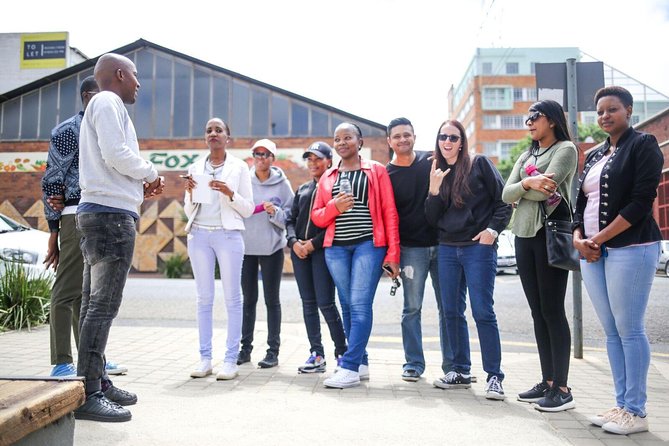
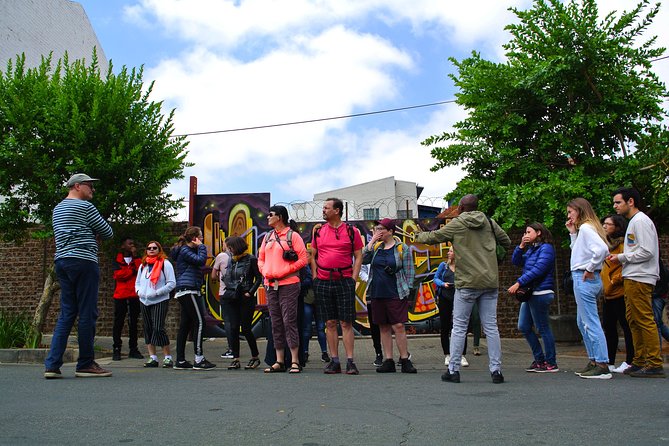
Johannesburg rewards curious walkers. This four-hour tour takes you beyond the usual bus-window view, linking Maboneng, old markets, Gandhi Square, and Mandela’s former law office with a local guide.
I like the small-group feel, with no more than 20 people, and the way the route mixes art, daily life, politics, books, and gold-mining history. I also like the chance to learn how Johannesburg’s public transport fits together instead of seeing the city only from an air-conditioned vehicle.
The main consideration is physical effort. You will walk through busy inner-city areas for several hours, and the tour may include a minibus ride rather than being entirely on foot, which could disappoint anyone expecting a continuous walking route.
In This Review
- Key points at a glance
- Why walking Johannesburg changes the experience
- Maboneng: Johannesburg’s Place of Light
- Kwa Mai Mai Market and the value of buying locally
- Collectors Treasury, eight floors of secondhand treasure
- Carlton Centre: Johannesburg from 223 meters up
- Gandhi Square and the old mining district
- Chancellor House and Mandela’s legal work
- The guides are central to the day
- What the $50.04 price includes
- Timing, meeting point, and what to bring
- Who should book this Johannesburg tour?
- Should you book it?
- FAQ
- How long does the Innercity Walking Tour last?
- Where does the tour begin and end?
- Is the tour entirely on foot?
- What is included in the price?
- Are lunch and refreshments included?
- How many people can join the tour?
Key points at a glance
- Maboneng opens the tour with street art and urban renewal, showing how a once-avoided district became a center for artists, designers, and small businesses.
- Kwa Mai Mai Market feels genuinely local, with traditional medicines, clothing, beads, walking sticks, and handmade goods across more than 176 stalls.
- Carlton Centre supplies the big picture, with a panoramic view from 223 meters above Johannesburg and a clear route through the city’s gold-rush, decline, and renewal.
- Chancellor House connects the city to Mandela and Tambo, whose law firm became South Africa’s first black-owned legal practice.
- Collectors Treasury is a delight for book lovers, with eight floors of used books, records, maps, postcards, and porcelain.
- The $50.04 price is reasonable for a four-hour guided introduction, especially since admission fees and transport are included, but lunch and drinks are not.
Why walking Johannesburg changes the experience
Johannesburg can be hard to read from a vehicle. A bus gives you distance and shelter, but it also keeps you apart from shopfronts, pavement life, public art, and the small changes between neighborhoods.
This tour uses walking as its main way of showing you the city. That matters because Johannesburg’s story is not contained in one museum or monument. It is spread across old mining districts, revived creative zones, markets, public squares, and buildings tied to the struggle against apartheid.
The route also helps you understand how the inner city fits together. You move between districts rather than visiting isolated sights, and the guide explains what you are seeing as the day unfolds. The result should feel less like ticking off attractions and more like learning how to read central Johannesburg.
There is a practical trade-off. The experience includes an air-conditioned vehicle, and one French-language comment described the day as a combination of walking and a personal minibus. If you want every kilometer on foot, ask about the transport arrangement before setting out. The vehicle can be useful in a large city, particularly when you need to cover ground, but the walking sections are the heart of the experience.
More Walking Tours in Johannesburg
- Soweto: Walking Tour with a Local Guide and Lunch
★ 4.9 · 648 reviews - Soweto Walking Tour with Lunch
★ 5.0 · 288 reviews - Johannesburg: Local Food Tasting Guided Walking Tour
★ 4.7 · 192 reviews
Maboneng: Johannesburg’s Place of Light
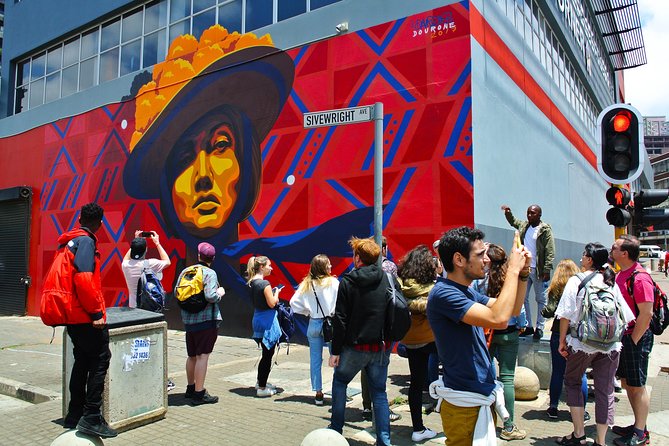
The first stop, Maboneng Precinct, gives you the tour’s clearest example of urban change. The name means Place of Light, and the district has become associated with Johannesburg’s creative energy.
Artists, designers, and entrepreneurs helped reshape an area once widely viewed as a no-go zone because of decay. The project placed art near the center of renewal, so you can expect the guide to discuss more than painted walls or stylish buildings. The important point is how a district’s image and use can change over time.
Allow about 45 minutes here. That is long enough for an introduction to the area, a look at its street art and creative character, and a chance to get your bearings. A short stop cannot explain every side of redevelopment, so keep your expectations sensible. You are seeing one part of a changing inner city, not receiving a complete account of Johannesburg’s social and economic challenges.
Maboneng is likely to be the easiest stop for visitors who enjoy photography and design. It also provides a gentle start before the route moves into older commercial and civic areas. I like this opening because it avoids presenting Johannesburg as only a city of crisis or only a city of fashionable renewal. It shows both the difficult past and the effort to make something new.
Kwa Mai Mai Market and the value of buying locally
Kwa Mai Mai Traditional Market is one of the tour’s most distinctive stops. It began as an old horse stable and now contains more than 176 stalls.
The market sells traditional medicines, African clothing, beaded items, artifacts, walking sticks, and craftwork. That makes it a better place for a meaningful souvenir than a standard tourist shop, particularly if you want an object connected to local traditions and makers.
You have about 30 minutes here. That is enough for an introduction and perhaps a purchase, but not enough to examine every stall at length. If you see something you want, do not assume you will have a second chance later in the day.
The guide’s presence is especially useful at a market such as this. Products can have cultural meaning that is not obvious at first glance, and a guide can give context while helping you move through the space with respect. You should still ask before photographing people, stalls, or goods.
This stop may feel less polished than Maboneng, and that is part of its appeal. It gives you a more direct look at commerce, tradition, and everyday city life. I would bring a little spending money if you enjoy local crafts, though lunch and refreshments are not included in the tour price.
Collectors Treasury, eight floors of secondhand treasure
Collectors Treasury is a quick stop, only about 15 minutes, but it adds welcome variety. The shop is described as the largest secondhand bookstore in the Southern Hemisphere, and books are stacked throughout its eight-storey building.
You may also find LPs, maps, porcelain, and postcards. The point is not simply to browse a shop. This place gives you a sense of Johannesburg’s older intellectual and collecting culture, with printed material and objects gathered in one wonderfully crowded building.
Fifteen minutes is a strict limit for anyone who enjoys old books. You will need to accept a quick look rather than a long search through the shelves. If a particular title catches your eye, ask the guide how much time remains before the group moves on.
For me, this is the kind of stop that helps a city tour feel personal. It is not a headline attraction, but it gives the route texture. You see a working place with its own character, not just a monument selected for a photograph.
Something quite different:
- From Johannesburg: Pilanesberg Nature Reserve Game Safari
★ 4.8 · 1,327 reviews - Johannesburg: Hop-On Hop-Off Bus with Optional Soweto Tour
★ 4.6 · 985 reviews - Soweto /Johannesburg and Apartheid Museum Guided Full Day Tour
★ 5.0 · 932 reviews - Johannesburg Hop-On Hop-Off City Tour with Soweto Option
★ 4.5 · 768 reviews
Carlton Centre: Johannesburg from 223 meters up
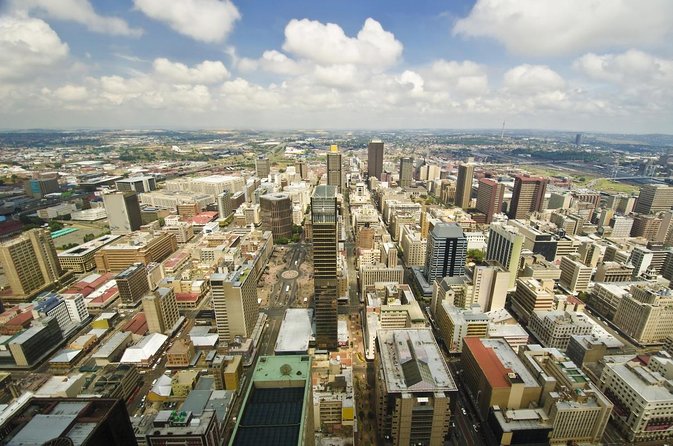
The Carlton Centre receives the longest stop, about one hour, and for good reason. Built between 1969 and 1976 by the American firm Skidmore, Owings and Merrill, the tower rises 223 meters above Johannesburg.
From the upper level, you get a panoramic view of the City of Gold. The view is useful because it turns the earlier walking route into a map. After seeing streets and buildings at ground level, you can look across the city and understand their place in the larger urban pattern.
The guide uses this stop to explain Johannesburg’s gold rush, which began in 1886, along with the city center’s decline during the late 1980s and 1990s and its more recent renewal. This broad timeline is one of the tour’s strongest features. It explains why old buildings, new creative districts, markets, and empty or changing spaces can exist close together.
Do not treat the Carlton Centre only as a viewpoint. The building itself reflects an earlier period when Johannesburg’s center represented corporate power and modern ambition. The view helps you see how the city grew around mining wealth and how its center later faced serious problems.
The drawback is simple: the panorama depends on conditions on the day. Even with a clear view, a city from above can become a quick photo stop unless you listen closely to the guide’s explanation. The full hour gives the history room to breathe, so this is where the quality of the commentary matters most.
Gandhi Square and the old mining district
Gandhi Square is a brief 20-minute stop named for Mahatma Gandhi, who spent 21 years in South Africa and operated his law office in downtown Johannesburg.
The square connects the city’s Indian community, Gandhi’s legal career, and the wider story of human rights in South Africa. A short stop cannot cover every chapter of Gandhi’s time in the country, but it gives your guide a clear point from which to discuss his local work and influence.
From here, the route moves through the Main Street mining district toward Chancellor House. This transition is valuable because it links the political story to Johannesburg’s economic beginning. The city’s gold-mining past is not an abstract museum subject. It shaped the streets, businesses, offices, and communities you are walking through.
The square is not the tour’s most visually dramatic stop, so you should approach it for context rather than spectacle. Its value comes from the people and events associated with the place.
Chancellor House and Mandela’s legal work
Chancellor House carries some of the strongest political meaning on the route. In the 1950s, this modest three-storey building housed Mandela and Tambo Attorneys.
The firm became South Africa’s first black-owned law practice. That fact gives the building weight beyond its size. You are looking at a place where legal work, racial injustice, and the resistance movement met in an ordinary downtown office.
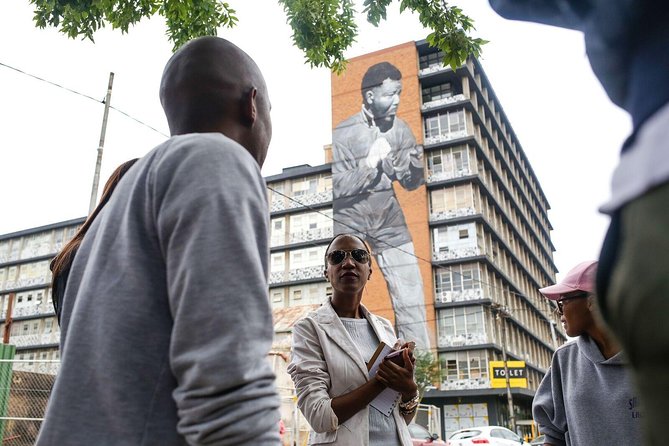
Across from the former law office is the Shadow Boxing Sculpture, designed by Marcos Cianfanelli and based on a famous photograph by Bob Gosani showing a young Mandela boxing. The sculpture adds a more personal image to the political story. It recalls Mandela not only as a statesman, but as a young man with energy, discipline, and ambition.
You have about 30 minutes here. That should allow time for the guide to explain the building and sculpture, along with the surrounding mining district. This is a stop where careful commentary matters more than the amount of time spent taking pictures.
I especially value the way Chancellor House closes the main route. You begin with current creative renewal in Maboneng and finish with a building tied to the country’s legal and political struggle. Johannesburg becomes a city shaped by ordinary buildings and people, not just famous towers.
The guides are central to the day
The route covers a lot in four hours. You move from art to traditional commerce, books, architecture, mining, Gandhi, Mandela, and public transport. Without a good guide, that mix could feel scattered.
The guide is expected to provide in-depth commentary while you walk, explain how to navigate public transportation, and add meaning to places that do not explain themselves. The strongest feedback attached to the experience praised the guides’ warmth, flexibility, and ability to reveal parts of the city that a standard sightseeing route would miss.
Thepso and Brite are two guide names associated with particularly positive comments. Thepso was praised for being accommodating and well informed, while Brite was described as friendly, cheerful, and able to introduce unusual places. Guide assignments can vary, so you should not assume one specific person will lead your date, but those comments point to the kind of personal approach the experience aims to provide.
A maximum of 20 people keeps the group from becoming enormous, though it is not a private tour. You may need to stay close to the guide in busy areas and wait for others at crossings or stops.
What the $50.04 price includes
At $50.04 per person, the price is fair for a four-hour guided city experience if you value interpretation and a route that reaches beyond the main tourist circuit.
Your fee includes the listed entrance fees, taxes, and use of an air-conditioned vehicle. That removes some small costs and makes budgeting easier. The Carlton Centre viewpoint, market visit, and other listed stops are built into the schedule rather than offered as optional extras.
Lunch and refreshments are not included. Since the tour begins at 10:00 a.m. and runs for around four hours, eat beforehand or plan for food afterward. Do not count on a meal being supplied during the route.
The value is strongest for a first visit to Johannesburg, especially if you want an introduction to the inner city without arranging several separate stops. You are paying for local explanation, movement between districts, and access to places that can be difficult to understand on your own.
The value is weaker if you prefer a slow, self-guided day. The schedule gives you limited time at each stop, and book lovers or market shoppers may want longer in both places. You also need to be comfortable sharing the day with a group of up to 20 people.
Timing, meeting point, and what to bring
The tour starts at 10:00 a.m. at 302 Fox Street in Jeppestown, Johannesburg, postal code 2043. It returns to the same meeting point at the end.
The starting point is near public transportation, and the tour itself is designed to help you understand how to get around the city. That is useful if you plan to continue exploring Johannesburg independently after the four-hour route.
Wear comfortable walking shoes and bring water, since the day includes several walking sections and a moderate level of physical fitness is required. A mobile ticket is accepted, and confirmation arrives when you book.
Keep your schedule flexible around the four-hour estimate. A group walking through central Johannesburg may take longer at a stop, and the balance between walking and vehicle travel can vary. If you need to catch a flight, train, or fixed appointment, allow extra time after the stated finish.
Free cancellation is available if you cancel at least 24 hours before the local start time. Changes or cancellations made less than 24 hours before departure are not accepted for a refund.
Who should book this Johannesburg tour?
I would choose this tour if you want history tied to real streets and buildings rather than a sightseeing loop viewed through glass. It suits first-time visitors who want a structured introduction to central Johannesburg, as well as repeat visitors looking for districts and markets outside the usual route.
It is a good match for you if you enjoy:
- Urban change and street art
- Political and social history
- Traditional markets and local crafts
- Architecture and city views
- Used books, records, maps, and old objects
- Learning how public transportation works
I would hesitate if you want a relaxed day with long stops, a meal included, or a fully private experience. The walking requires moderate fitness, and the route covers a lot of ground in four hours.
Should you book it?
Book it if you want to meet Johannesburg at street level. Maboneng gives you creative renewal, Kwa Mai Mai offers traditional goods and everyday commerce, Collectors Treasury adds an unexpected literary stop, and Carlton Centre puts the whole city into view.
The best reason to go is the connection between these places. The route shows how Johannesburg’s gold wealth, urban decline, political struggle, and current renewal overlap in the same center.
Skip it if you prefer a slow museum day or dislike group walking. For everyone else, the $50.04 cost buys a useful introduction, strong historical framing, and a route you might not assemble easily by yourself.
FAQ
How long does the Innercity Walking Tour last?
The tour lasts approximately four hours.
Where does the tour begin and end?
It begins at 302 Fox Street, Jeppestown, Johannesburg, 2043, South Africa, at 10:00 a.m. The tour ends back at the same meeting point.
Is the tour entirely on foot?
The experience focuses on walking, but an air-conditioned vehicle is included. The balance may include walking and minibus travel.
What is included in the price?
The price includes the listed entrance fees, all taxes, and use of an air-conditioned vehicle.
Are lunch and refreshments included?
No. Lunch and refreshments are not included.
How many people can join the tour?
The group can have a maximum of 20 people.
Just added in Johannesburg
- Pilanesberg and Sun City Tour★ 5.0 · 24 reviews
- Pilanesberg Wildlife Safari★ 5.0 · 4 reviews
- Pilanesberg National Park Tour★ 5.0 · 17 reviews
- Full day Pilanesberg Safari Tour★ 5.0 · 14 reviews
- Pilanesberg Nature Reserve & Safari Park Lion Private★ 4.0 · 4 reviews
- Bush Babies & Monkey Sanctuary and Elephants walk Private★ 5.0 · 12 reviews
- Discover the Pilanesberg with a personalized full day safari★ 5.0 · 20 reviews
- 2 Days Pilanesberg National Park Luxury Safari★ 5.0 · 4 reviews
Walking Tours, compared.



Browse the lists this tour appears in